7 Types of Branding (and How to Know Which One Your Business Needs)
Most businesses don't have a branding problem. They have a branding confusion problem. Here's how to pick the right type before you design anything.
 Cover Image
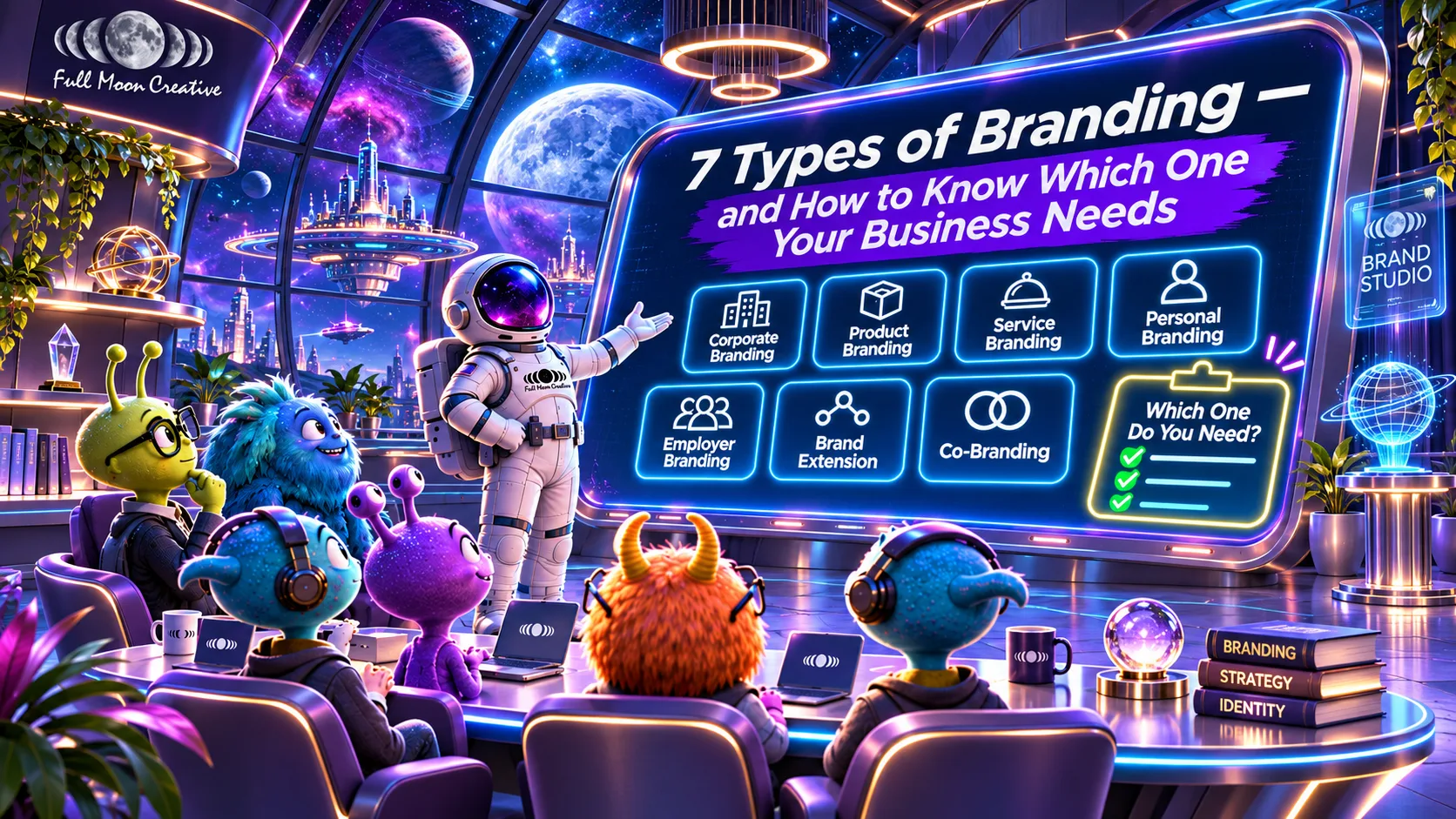
Quick answer: There are seven main types of branding: corporate, product, service, personal, employer, retail and place branding. Each one solves a different perception problem: differentiation, recognition, trust, authority, talent attraction, the in-store choice or a sense of place. The right type depends on one question: whose perception do you need to change, and about what?
Key takeaways
- There are seven types of branding, and they are not interchangeable.
- Each type solves a different perception problem for a different audience.
- The most common branding mistake is choosing the type, or the logo, before defining the problem.
- Full Moon Creative's process runs in this order: Problem → Brand Level → Strategic Decision → Expression.
- One question points to the right type: whose perception are we trying to change, and about what?
Most businesses don't have a branding problem
They have a branding confusion problem.
A founder says, "We need branding." But that sentence can mean seven different things: a company brand, a product brand, a service brand, a personal brand, an employer brand, a retail brand or a place brand. They are not interchangeable, and treating them as one is where most branding projects go sideways.
This guide breaks down the seven types of branding, the specific problem each one solves, and the four-step process we use at Full Moon Creative to pick the right one before anyone opens a design file.
What is branding?
Branding is the work of shaping what a specific audience understands, remembers and associates with a company, product, service, person or place. A logo, color palette and video style are part of branding, but they are its expression, not the strategy behind it.
That distinction matters, because every type of branding below starts with strategy and ends with expression.
What are the 7 types of branding?
1. Corporate branding
Corporate branding is the practice of shaping how a company as a whole is understood: what it stands for, what it's known for and why it's different. It sits above every product and service the company sells.
- Solves: differentiation
- Best for: companies whose reputation lags behind the quality of their work, or that compete in a crowded category
2. Product branding
Product branding makes a specific product recognizable and preferable when buyers compare options. It covers the product's name, packaging, visual identity and core promise.
- Solves: recognition and preference
- Best for: launching or relaunching a product that has to win on its own
3. Service branding
Service branding makes an intangible service easier to understand, trust and remember. Customers can't hold a service before they buy it, so the brand has to carry the proof through clarity, consistency and visible results.
Trust is not a soft metric. In Edelman's 2019 In Brands We Trust? study of 16,000 consumers across eight countries, 81% said being able to trust a brand to do what's right was a deal breaker or deciding factor in buying, yet only about one in three said they trust most of the brands they use (Edelman).
- Solves: trust
- Best for: law firms, medical practices, contractors, agencies and other service-based businesses
4. Personal branding
Personal branding builds recognition and reputation around one person's expertise, perspective and identity. For many companies, the founder is the first thing a prospect trusts.
- Solves: authority
- Best for: founders, executives, attorneys and consultants whose name drives the business
5. Employer branding
Employer branding shapes how current and future employees see a company as a place to work. It answers the question every candidate asks: why here instead of somewhere else?
The business case is measurable. LinkedIn Talent Solutions research found that a strong employer brand can cut cost-per-hire by 50% and turnover by 28% (LinkedIn).
- Solves: relevance to talent
- Best for: growing companies competing for skilled people or working to keep the ones they have
6. Retail branding
Retail branding turns the physical buying environment into part of the brand. Layout, signage, screens, lighting, sound and staff all reinforce the customer's decision while they're standing in it.
- Solves: reinforcing the choice in the moment
- Best for: storefronts, showrooms, dealerships, restaurants and any business where the purchase happens in person
7. Place branding
Place branding creates distinctive meaning around a city, neighborhood, destination or venue. It shapes how residents, visitors and businesses feel about a location and what they expect from it.
- Solves: distinctive meaning for a location
- Best for: municipalities, downtown development authorities, tourism boards and destination venues
Each type of branding solves a different problem
These are not seven versions of the same branding exercise. Each one solves a different meaning problem, for a different audience.
| Branding type | The problem it solves | Who needs to believe it |
|---|---|---|
| Corporate | Differentiation | Customers, partners, investors |
| Product | Recognition and preference | Buyers comparing options |
| Service | Trust | Prospects who can't try before they buy |
| Personal | Authority | Prospects, peers, media |
| Employer | Relevance to talent | Candidates and current employees |
| Retail | Reinforcing the choice in the moment | In-person shoppers |
| Place | Distinctive meaning for a location | Residents, visitors, businesses |
Pick the wrong row and you can produce excellent work that solves the wrong problem.
What happens when the problem sits between brand levels?
Sometimes the real problem isn't inside one type of branding. It sits in the gap between two of them.
- People trust the founder but don't understand the company. The personal brand is strong; the corporate brand is thin.
- The product is recognizable, but the parent brand is invisible. Buyers know what they're buying, not who makes it.
- The visual identity is beautiful, but customers still don't get the positioning. The expression is finished; the strategy isn't.
In each case, more design won't fix it. The fix is a strategic decision about which brand level should carry the meaning, and how the levels connect.
How do you choose the right type of branding?
Work backwards: define the problem first, then the audience, then the strategy, and design last. Choosing the branding type first is the most common mistake we see. At Full Moon Creative, we decide the problem before we decide the type, and the type before we design anything.
- Problem. What are we trying to make easier: recognition, preference, trust, recruitment or reputation?
- Brand level. Who needs to believe it? The answer usually tells you which type of branding you're in.
- Strategic decision. What should that audience understand, remember and associate with the brand?
- Expression. Only now do logo, color, messaging, video and environment become useful, because they finally have a target.
The common shortcut runs the other way: logo, then colors, then "make it premium." That order produces polished work with nothing to aim at, and it's an expensive mistake to undo.
The one question to ask before any design work
Before we touch a logo, a color palette or a camera, we ask:
Whose perception are we trying to change, and about what?
Get that right and the whole brand conversation changes. The brief gets sharper, the scope gets smaller, and every creative decision has something to be measured against.
Here's how the answer points to the right type:
- A city launching a downtown initiative needs residents and visitors to see the district differently. That's place branding.
- A growing HVAC company that can't hire technicians needs candidates to see it as a great place to work. That's employer branding.
- A law firm whose founding attorney is well known, but whose firm name isn't, needs prospects to trust the firm itself. That's corporate branding built on the founder's authority.
About Full Moon Creative
Full Moon Creative is a creative and production agency headquartered in Sunrise, Florida. Founded in 2005 by Dwight Moon and Howard Attias, the company brings video production, live event production, digital marketing, AV installations, government and PEG AV and live streaming under one roof, to one creative standard. Full Moon Creative is a certified Small Business in Broward County and serves corporate brands, service-based businesses and municipal governments across South Florida.
Every engagement starts with your definition of winning: more leads, a memorable brand, a successful launch or a city campaign that actually reaches residents. Then we work backwards to the branding that gets you there.
Not sure which brand problem you're actually solving? Book a low-pressure discovery call with our team. Discovery is free, and we reply within one business day to set it up.
Sources
- Edelman, 2019 Edelman Trust Barometer Special Report: In Brands We Trust?
- LinkedIn Talent Solutions, How employer brand drives job consideration