The 7-11-4 Rule: Why Content Is the Engine of Your Business's Future
Before anyone hands you their money, they've already spent hours getting to know you. Here is how much, and why content is how you show up for it.
 Cover Image
Quick answer: The 7-11-4 rule says buyers need about 7 hours of interaction with a brand, across 11 touchpoints, in 4 different places before they buy. It's a marketing rule of thumb often credited to Google, built on Google's research into the "Zero Moment of Truth." For business owners, it means steady content, especially video, across several channels is what turns strangers into customers.
Every week, a business owner asks us some version of the same question: "Why do I need all this content? I just need more customers."
Here's the honest answer: content is how you get more customers now. Not because it's trendy, but because of how people decide who to buy from.
Before anyone hands you their money, they've already spent hours getting to know you. Usually without you even knowing it. There's a simple rule of thumb that explains exactly how much: 7-11-4.
What is the 7-11-4 rule?
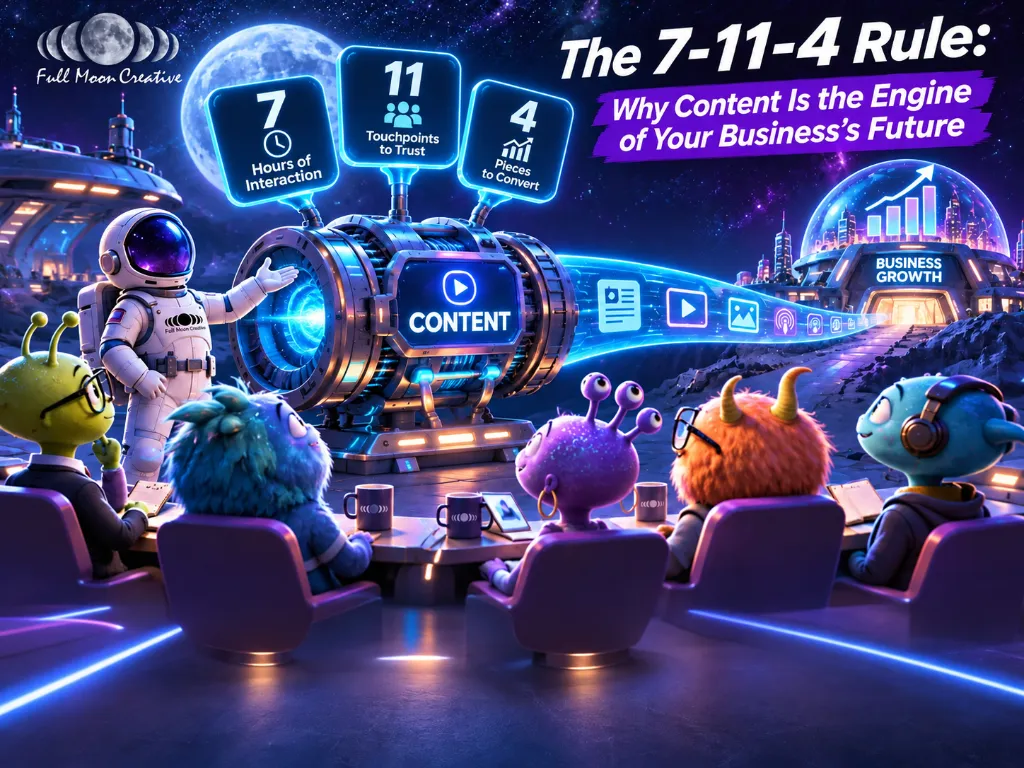
Before most people buy, they need about 7 hours of interaction with your brand, across 11 touchpoints, in 4 different places.
- 7 hours: the total time someone spends with you. Watching your videos, reading your website, scrolling your posts, sitting through your webinar.
- 11 touchpoints: separate moments of contact. A search result, a reel, a review, an email, a referral, a visit to your site.
- 4 locations: the different places they run into you. Google, your website, social media, YouTube, an event, their inbox.
The rule is often credited to Google. It builds on Google's 2011 research into how people check out a business before they buy, the stage Google calls the "Zero Moment of Truth," though Google never published these exact numbers. Treat them as a rule of thumb, not a stopwatch. The point holds either way: trust is built over time, in more than one place.
Why can't one ad or video carry the load?
Most businesses still market like it's one shot. One commercial. One brochure. One website built five years ago. Then they wonder why it didn't "work."
Do the math. A 30-second ad is half a minute of your 7 hours. A homepage visit might be two minutes. Even a great brand video is three or four. No single piece gets anyone close.
And your buyers are checking you out everywhere. They Google you, read your reviews, scroll your Instagram and ask a friend. If you only show up in one of those places, your competitors fill the gaps. Or silence does, and silence looks like you're closed.
Why is content the driver of your business's future?
Here's the shift: content isn't a marketing expense you tack on. It's the engine that builds trust before you ever get on the phone. Three reasons it drives your future:
- It works while you don't. A video you make once can answer questions, show your work and build confidence around the clock, for years.
- It compounds. Every video, post and article adds to the hours someone can spend with you. Ads stop when the budget stops. Content keeps working.
- It's how you get found now. People search Google, YouTube and AI assistants for answers. The businesses with clear, helpful content are the ones that show up and get recommended.
The businesses that win the next five years won't be the loudest. They'll be the ones buyers already feel like they know.
How does content get you found? SEO, AEO and GEO
Search engines and AI tools are now two of your four places. Content is what gets you into them.
- SEO (search engine optimization) gets you ranked on Google when people search for what you do. It rewards pages that answer real questions and spell out who you are, what you do and where.
- AEO (answer engine optimization) gets your business picked as the answer. Think Google's featured snippets, AI Overviews and voice assistants. Short, clear question-and-answer content wins here.
- GEO (generative engine optimization) gets you mentioned inside AI tools like ChatGPT, Gemini and Perplexity. These tools lean on brands that show up consistently and credibly across many sources.
Notice the pattern? It's 7-11-4 again. The more useful content you publish in more places, the more often you're the business that gets found, quoted and recommended.
What does the 7-11-4 rule look like in real life?
You don't need 11 separate projects. You need one smart plan and good raw material. Here's a realistic path for a local service business, say a law firm or an HVAC company, from stranger to signed client:
| # | Touchpoint | Where | Time |
|---|---|---|---|
| 1 | Sees a 30-second reel about a problem they have | Social media | 1 min |
| 2 | Searches the problem, finds your how-to video | Google & YouTube | 10 min |
| 3 | Reads your Google reviews | Google & YouTube | 15 min |
| 4 | Visits your website, watches your brand video | Your website | 20 min |
| 5 | Reads your FAQ and two blog posts | Your website | 25 min |
| 6 | Sees a client testimonial video in their feed | Social media | 10 min |
| 7 | Downloads your guide and reads it | Your website | 30 min |
| 8 | Binges your YouTube series | Google & YouTube | 2 hrs |
| 9 | Follows you; watches a month of posts and stories | Social media | 1 hr |
| 10 | Meets your team at a community event | In person | 1.5 hrs |
| 11 | Books a consultation | In person | 45 min |
Add it up: about 7 hours, 11 touchpoints, 4 places. Notice how much of it is video, and how little of it needed you in the room.
That's the production secret. One well-planned shoot day can give you a brand video, client testimonials, a how-to series and a stack of short clips for social. One investment covers most of that table.
How do you put the 7-11-4 rule to work?
You don't have to build all 7 hours this month. Start here:
- Audit your touchpoints. List every place a buyer can find you today. Be honest about what's outdated or missing.
- Pick your four. Choose the four places your buyers actually spend time. For most local businesses that's Google, your website, one social platform and YouTube.
- Answer your top 10 questions. Turn the questions your team hears every week into short videos and posts. Nothing builds trust faster.
- Capture proof. Film real clients telling real stories. A testimonial sells harder than anything you say about yourself.
- Plan in batches. One shoot day, planned well, can fuel months of content.
How does Full Moon Creative build a 7-11-4 content plan?
We map where your buyers already meet you, pick the four places that matter, then fill the gaps with content planned in batches and produced by one in-house team. Full Moon Creative has helped South Florida businesses and cities tell their stories since 2005, with video production, live events, digital marketing and live streaming all under one roof.
- Discovery call. A short, no-pressure conversation about what winning looks like for you. We reply within one business day to set it up.
- Touchpoint audit. We walk through your 7-11-4 with you: where buyers find you today, what's outdated, and what's missing.
- A plan for your four. Which pieces to make first, where each one runs, and what it should answer, with a custom line-item quote.
- Batch production. A typical social content day produces 6 to 12 short-form vertical videos, and the same shoot can capture testimonials and your brand video. Every edit includes two revision rounds.
- Yours to keep. You own the final videos outright with unlimited usage, so the hours of content you build keep working on every channel. Payment is a 50% deposit and 50% on delivery.
Not sure where your gaps are? Book a discovery call and we'll show you what to build first. No pressure, just a plan.
About Full Moon Creative
Full Moon Creative is a full-service creative and production agency headquartered in Sunrise, Florida. Founded in 2005 by Dwight Moon and Howard Attias, it delivers video production, live event production, digital marketing, AV installations and live streaming under one roof. Full Moon Creative is a certified Small Business in Broward County and serves corporate, service-based and municipal clients across South Florida.
Sources
- Google / Think with Google: Winning the Zero Moment of Truth (2011)