
How to Reach the Google Map Pack's Top 3 in 30 Days: A Local SEO, AEO & GEO Game Plan
The Map Pack isn't out of reach for your business. It rewards the right signals stacked in the right order. Here's a focused 4-week plan to fix your foundation, build authority, stack reviews, and stay visibly active, plus how the same work gets you cited in AI answers.
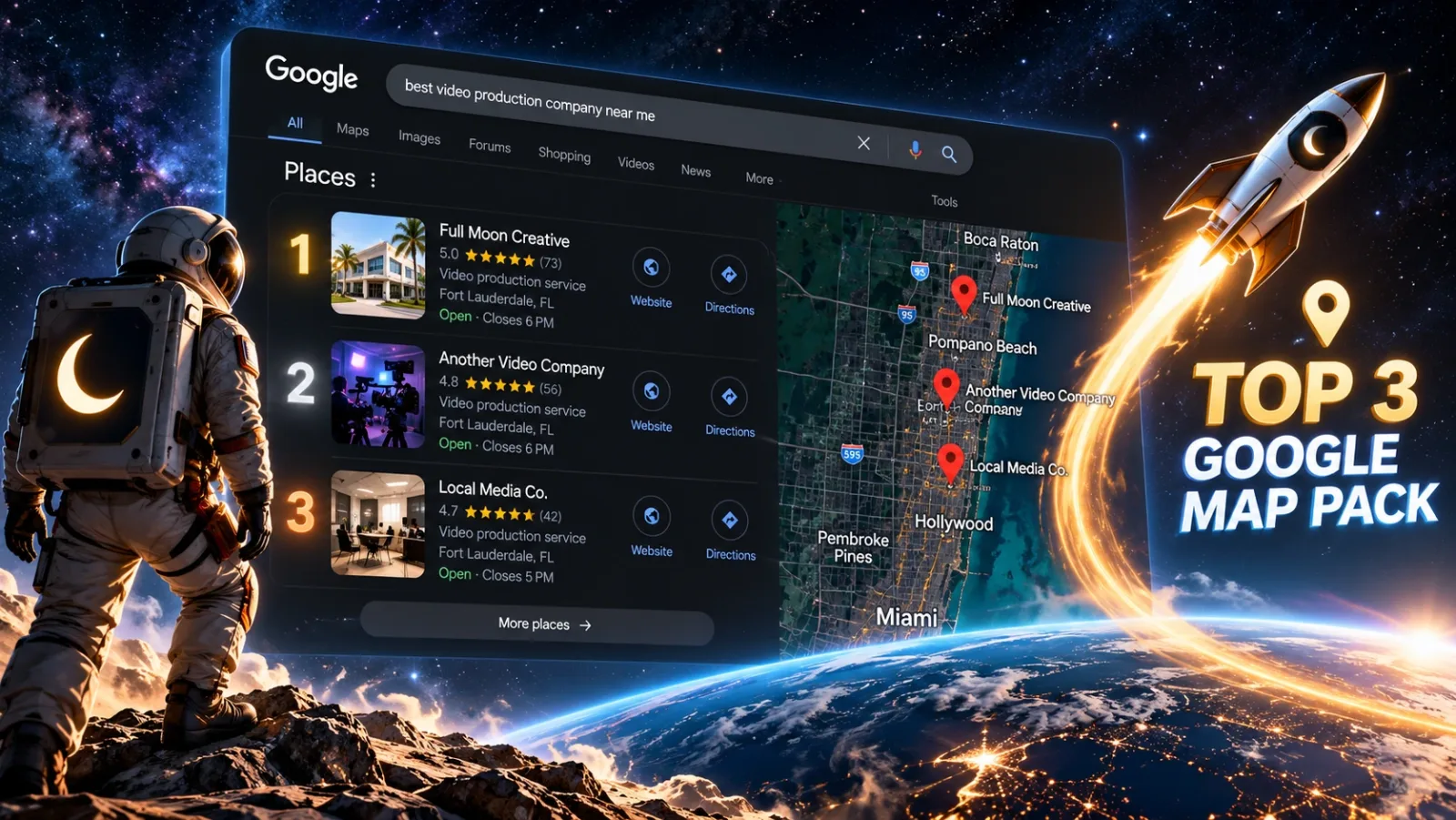 Cover Image
Short answer: The Google Map Pack isn't out of reach for your business. It rewards the right signals stacked in the right order. A focused 4-week plan covers Week 1: fix your foundation (profile + NAP), Week 2: build citations, Week 3: stack reviews, Week 4: stay active (posts + links). Competitive markets can take longer than 30 days, but this sequence is the fastest path we know to get into the top 3.
Key takeaways
- The Map Pack is the block of three local listings Google shows above or alongside regular results for "near me" and local searches.
- Google weighs relevance, distance, and prominence. You can't change distance, but you can influence the other two.
- Order matters: a clean profile first, then authority, then reviews, then consistent activity.
- The same signals that win the Map Pack also help you get cited in AI answers (ChatGPT, Gemini, Perplexity, Google AI Overviews).
What is the Google Map Pack?
The Map Pack (also called the Local Pack or "3-pack") is the map plus three business listings Google displays when someone searches with local intent, such as "personal injury lawyer in Miami," "video production Fort Lauderdale," or "AV installer near me."
These three spots capture a huge share of the clicks, calls, and direction requests for local searches. Being outside the top 3 usually means being invisible to people ready to buy.
What is the Google Map Pack? The Google Map Pack, also called the Local Pack or 3-pack, is the map and three business listings Google shows for searches with local intent, like "video production Fort Lauderdale" or "AV installer near me." Google ranks those listings on relevance, distance, and prominence, and the top three spots capture much of the calls, clicks, and direction requests from people ready to buy.
How does Google decide who makes the top 3?
Google says local results are based mainly on three factors:
| Factor | What it means | What you control |
|---|---|---|
| Relevance | How well your profile matches what the person searched | Categories, services, description, website content |
| Distance | How close you are to the searcher or searched location | Little, but accurate address and service area help |
| Prominence | How well-known and trusted you are | Reviews, citations, links, brand mentions, activity |
Most businesses stall because they chase prominence (reviews, links) before fixing the basics. That's why the plan below is sequenced.
The 30-day plan
Week 1: Fix the foundation (profile + NAP)
You can't build authority on a shaky base. Start here.
Google Business Profile checklist
- Claim and verify your profile.
- Choose the most accurate primary category, then add relevant secondary categories.
- Write a clear business description that naturally includes your services and the cities you serve.
- Add every service you offer, with short descriptions.
- Set accurate hours, including holiday hours.
- Add real photos and video: your team, your location, your work.
- Make sure your website link points to the most relevant page, not just the homepage when a better one exists.
NAP consistency
NAP stands for Name, Address, Phone. Your NAP should be identical everywhere it appears: your website, Google Business Profile, social profiles, and directories.
- Pick one official format ("Suite" vs "Ste.", "Street" vs "St.") and use it everywhere.
- Use one primary phone number.
- Put your NAP in the site footer and on your contact page, in text (not just an image).
Week 1 goal: A complete, accurate, consistent profile that tells Google exactly who you are, what you do, and where you do it.
Week 2: Build citations (authority signals)
A citation is any online mention of your business name, address, and phone number. Citations confirm to Google that you're real and established.
- Submit to major data aggregators and the directories that matter most (Apple Maps, Bing Places, Yelp, Facebook, and the general directories people actually use).
- Add industry-specific and local directories: chambers of commerce, trade associations, and local business groups.
- Audit existing listings. Fix duplicates, outdated addresses, and old phone numbers. Inconsistent citations quietly hurt rankings.
- Keep every listing's NAP identical to your Week 1 format.
Week 2 goal: Consistent, trustworthy mentions of your business across the web.
Week 3: Stack reviews (prominence wins)
Reviews are among the most visible prominence signals, for Google and for the humans reading them.
- Ask every happy customer. Make it easy with a short direct review link, a QR code, or a follow-up text or email.
- Aim for a steady flow, not a burst. A sudden spike followed by silence looks unnatural.
- Reply to every review, positive and negative. Responses show you're active and care.
- It helps when reviewers mention the specific service and city, as long as it comes naturally. Never script or incentivize reviews; that violates Google's policies.
Week 3 goal: A growing, recent, authentic set of reviews with a consistent response habit.
Week 4: Stay active (posts + links)
Local rankings reward businesses that are visibly alive.
- Publish Google Business Profile posts weekly: updates, offers, projects, events.
- Keep adding fresh photos.
- Earn local links: sponsor a local event, partner with neighboring businesses, get featured in local press or community sites.
- Publish helpful content on your website that targets local questions, and link it back to your service pages.
- Keep your profile current as your services, hours, and photos change.
Week 4 goal: Ongoing momentum so your ranking sticks and keeps improving after day 30.
Why does this also work for AEO and GEO?
Search has expanded beyond ten blue links. People now ask AI assistants for recommendations, and those tools pull from the same trust signals.
- AEO (Answer Engine Optimization) is about being the direct answer in featured snippets, voice search, and AI summaries.
- GEO (Generative Engine Optimization) is about being cited or recommended by generative AI tools.
How to support both while you work the 30-day plan:
- Lead with answers. Put a 40 to 80 word direct answer near the top of key pages, like the one at the top of this article.
- Use clear question-based headings ("How much does X cost in Fort Lauderdale?").
- Keep entity details consistent. Your name, services, location, and contact info should read the same everywhere. AI models cross-check sources.
- Add structured data (LocalBusiness and FAQPage schema) so machines can read your details accurately. Skip review star markup on your own business; Google doesn't show self-serving review stars.
- Earn mentions on trusted third-party sites. Reviews, directories, and press coverage reinforce that you're a real, reputable business.
- Write in plain language with specific facts: services, service areas, years in business, certifications.
Common mistakes that keep businesses out of the top 3
- Choosing the wrong primary category
- Inconsistent NAP across directories
- Keyword-stuffing the business name (a policy violation that can get you suspended)
- Ignoring reviews or never replying
- Posting once and disappearing
- Using a virtual office or PO box address
- Expecting results from reviews alone without fixing the foundation
Ready to take your spot in the top 3?
If you'd rather have a team handle it, Full Moon Creative helps South Florida businesses get found on Google and in AI search, and our in-house video and content teams can make your profile and website stand out once you're there. Book a free discovery call and we'll start with where your profile stands today.