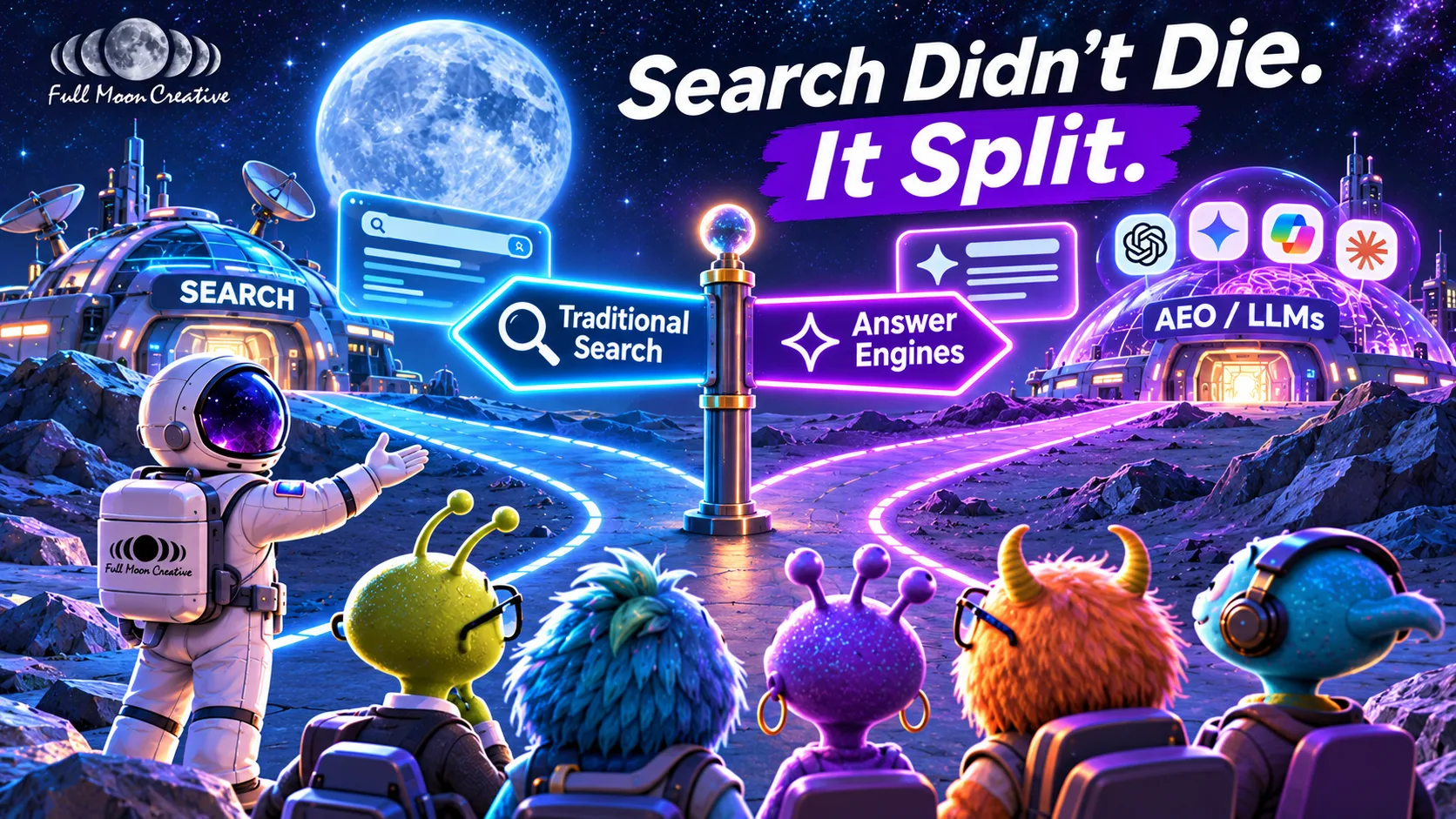
Search Didn't Die. It Split.
Your customers didn't stop searching. They just stopped searching in one place.
 Cover Image
Quick answer: Search split into three front doors: classic Google results, AI Overviews and chatbot answers. SEO earns the click, AEO earns the quote, and GEO earns the recommendation. Most of the work overlaps, so the businesses that win show up at all three, with long-form video as the one asset that reaches every door.
Your next customer might find you through a classic Google result, an AI-generated overview, or a chatbot answer that cites one source and skips the rest. Same question. Three different front doors. And each one picks winners differently.
For twenty years the playbook was simple: rank on page one, earn the click, get the call. That playbook still matters. It just isn't the whole game anymore. Here's what changed, what didn't, and how to make sure your business shows up no matter which door your customer walks through.
Three front doors, three playbooks: SEO, AEO and GEO
Each front door has its own playbook, and you've probably heard the acronyms thrown around. Here's what they actually mean.
| Front door | What your customer sees | The playbook | What it earns you |
|---|---|---|---|
| Classic Google result | Blue links, the map pack, your Business Profile | SEO: Search Engine Optimization | The click |
| AI Overview | A summary at the top of Google, with a few source links | AEO: Answer Engine Optimization | The quote |
| Chatbot answer | ChatGPT, Gemini, Perplexity or Google's AI Mode recommending a business | GEO: Generative Engine Optimization | The recommendation |
SEO isn't going anywhere. Google is still the biggest door, and the searches that make you money still get clicked. SparkToro's 2026 research found branded searches, local business searches and ready-to-buy searches still reward SEO. Someone typing "corporate video production Fort Lauderdale" wants a company, not a summary.
AEO is the door most people walk through without noticing. Google's AI Overviews now reach more than 2.5 billion people a month, and they show up on more than one in five U.S. Google searches.
GEO is the fastest-growing door. Google's AI Mode, its chatbot-style search, passed 1 billion monthly users about a year after launch. ChatGPT's app passed 1 billion monthly users in May, according to Sensor Tower estimates, and Google's Gemini app is at more than 950 million.
The lines blur. AI Overviews and chatbots lean on many of the same signals. But the split is useful: SEO earns the click, AEO earns the quote, GEO earns the recommendation. You want all three.
What actually changed: the click got smaller and the shortlist got shorter
Fewer searches end in a click. In the first four months of 2026, 68% of U.S. Google searches ended without a click, up from about 60% in 2024. People got their answer right on the page.
Page one isn't the prize it used to be. When an AI Overview shows up, the top-ranking page gets 58% fewer clicks than a top result on a similar search without one, per an Ahrefs study of 300,000 keywords. Position two gets about half as many clicks. Even position ten loses close to 20%.
The shortlist is the new page one. A chatbot doesn't show ten options. It names a few businesses and moves on. Ranking fourth used to still earn you a call. In an AI answer, if you're not named, you don't exist.
Here's the upside most people miss. When an AI names you, the customer often doesn't click. They search your name later, or they just call. Branded searches still click, so getting named in AI answers feeds your SEO instead of competing with it. The scoreboard changed from "how much traffic did we get" to "how often are we the answer."
How to show up at all three doors
The good news: you don't need three separate strategies. Most of this work pays off at every door. But each playbook has a few moves that matter most.
SEO: earn the click
- Treat your Google Business Profile like a storefront. Right categories, every service listed, real photos, current hours. For local businesses, it's often the main event.
- Ask every happy client for a review. Reviews move rankings and they feed AI answers too.
- Build one page per service and per city you serve. "Event production in Sunrise" beats a generic Services page.
- Keep the basics clean. Fast, mobile-friendly, and every important page indexable. Nothing fancy, just no excuses.
AEO: earn the quote
- Answer first, explain second. Put the direct answer in the first sentence. AI lifts clean answers and skips vague ones.
- Write down what your sales team hears every week. "How much does a corporate video cost?" "How far ahead should we book?" Each one deserves a clear, honest answer on your site.
- Label your pages for machines. Schema markup tells Google what a page is: a business, a service, an FAQ. It has to match what's visible on the page.
- Structure for extraction. Clear headings and short paragraphs let a machine grab the exact passage it needs.
GEO: earn the recommendation
- Get talked about. Reviews, local press, industry directories, client case studies, podcast interviews. AI recommends businesses other sources vouch for, not just businesses with nice websites.
- Make your facts identical everywhere. Same name, address, phone, services and service area on every profile. Mixed signals make AI hedge, and hedging means it names someone else.
- Publish what only you have. Real project results, case studies, pricing ranges, years in business. Specifics get cited. Fluff doesn't.
- Ask the robots. Once a month, ask ChatGPT, Gemini, Perplexity and Google's AI Mode the questions your customers ask. Note who gets named. That's your new rank report.
The play that hits all three: video
YouTube was the most-cited platform across eight AI tools in August 2026, ahead of Reddit. Google owns YouTube, so a good video can rank in classic search, get pulled into an AI Overview and get cited by a chatbot. One asset, three doors.
The catch: AI cites a specific kind of video. In one study, 94% of YouTube citations went to long-form videos, not Shorts. Subscriber count barely mattered. What mattered was a clear answer to one real question, chapters with descriptive names, and a detailed description. Shoot the video, publish it with chapters, and put the same answer in writing on your site.
Every door, one team
Search didn't die. It split. The businesses that win next year will show up at every door: the ranking, the overview and the answer.
That's how Full Moon Creative has always worked. Since 2005, we've kept video production, digital marketing, live events and AV under one roof in Sunrise, Florida. The team building your SEO, AEO and GEO strategy is the same team shooting the videos that get cited. No stitching together an SEO agency, a content shop and a video crew.
We start every engagement the same way: by asking what winning looks like for you. More leads? More calls from a specific city? Getting named when someone asks ChatGPT for the best in your field in South Florida? Then we build the work around that goal, with monthly reporting against pipeline and ROI so you can see which doors are opening. On the video side, every edit includes two revision rounds and you own the final videos outright, so the long-form answers you publish keep working on every channel.
Want to know which doors you're showing up at? Book a low-pressure discovery call with Full Moon Creative. We'll talk through where customers find you today and where you're missing.